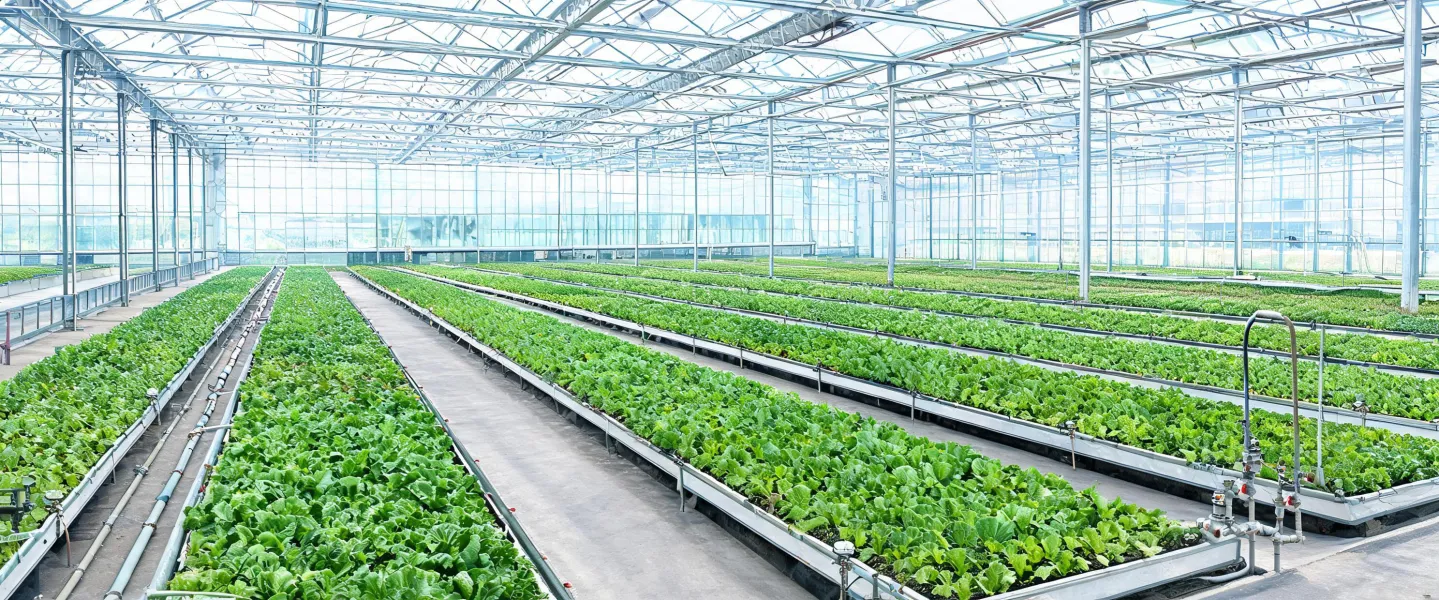
Large commercial greenhouse requirements by application
A larger footprint changes circulation, construction stages and system interfaces. Define the growing task before comparing area-based structure quotations.
Four production contexts to describe
01 / fruiting vegetables
Long crop rows and trellis infrastructure
Describe crop type, growing method, row spacing and operational access. Ask whether trellis loads and irrigation distribution sit within the structure supplier's scope. A building footprint alone does not define usable growing area or a crop production result.
02 / propagation
Separate young-plant environments
Identify benches, irrigation zones, hygiene access and humidity control. Specify zone boundaries and service aisles before requesting a climate package. One control zone may cost less initially while offering less flexibility than independently managed compartments.
03 / floriculture
Screening and light schedules
Record light deprivation, shade-screen and ventilation needs separately. Ask for the covering datasheet and screen travel arrangement. Glass, polycarbonate and film should be compared for the exact crop schedule, maintenance access and replacement plan rather than a universal quality ranking.
04 / phased expansion
Construction beside an operating crop
Describe road access, unloading space, existing utilities and the connection to future bays. Request a staged packing and delivery proposal. Field access and local installation resources can affect a project even when factory manufacturing time is unchanged.
Check the boundary of your application brief
Use this local checklist to prepare the request; the choices are planning aids and are not submitted as extra backend fields.
Verification path: give shortlisted factories the same plan; request their marked-up scope, covering datasheet and structural calculation basis; ask the designated project professional to resolve load and foundation assumptions before purchase. A supplier document is evidence for its named configuration, not automatic approval for the destination.
For a restricted budget, compare a smaller initial phase with a larger basic structure. The former may preserve crop-control scope; the latter may defer equipment or add operating work. Neither route establishes better yield without a crop and site assessment.
Include structure and covering, dimensions and bay layout, crop, quantity and destination. Identify any unconfirmed engineering or installation responsibility so alternatives remain visible.